
 Johnson County Community College was founded in 1969 by visionary leaders who knew this County had great potential as a place to live, work, play and get an education. Like many pioneers, the folks who took on this project faced many challenges and questions - why buy so much land way out in the middle of nowhere for $10,000 an acre? Well, like any good pioneers, our college's founders did not let the naysayers and negative voices stop them, and Johnson County voters established JCCC at College and Quivira and funded the college through a dedicated property tax levy.
Fifty years later, the value of that vision can be seen today. In fact, it could easily be said that our founders' vision was too narrow, and that more acreage for the growing campus would have been even better. The College now includes other locations around Johnson County, as we try to reach as many citizens as we can with valuable programs. Since I was first elected in 2011 we have opened the Olathe Health Education Center next to and in cooperation with Olathe Medical Center, continued to efficiently rent space in northern Overland Park and at the KU Edwards campus, and have expanded online programming. In addition, the Wylie Hospitality and Culinary Academy was completed on campus to allow our world championship quality culinary program the equipment, space and tools to grow even better. In 2019 we will open a new Fine Arts and Design building and the new Hugh Libby Career and Technical Education Center, as well as other important, long-term physical improvements to the campus (and all without a property tax increase).
JCCC is a comprehensive community college, touching over tens of thousands of credit and non-credit students each year. Its credit enrollment for the Spring semester of 2019 is almost 20,000 credit students. Our college rivals KU and K-State as one of the three largest undergraduate campuses in Kansas! In addition to offering college credit courses, the college offers certificate programs, continuing education programming, job training, adult education programs (GED and ESL), and technical programs like HVAC, welding, electrical and electronics programs, and automotive mechanics. Yardley Hall and the Polsky Theater host world class cultural and entertainment events and the Nerman Museum of Contemporary Art brings art, artists and fans to campus on a daily basis.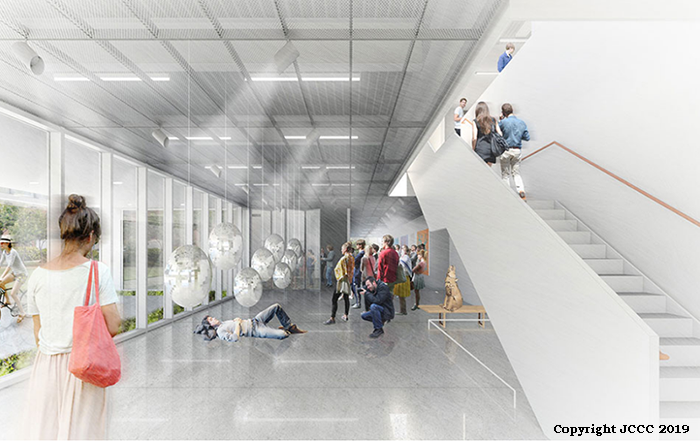
A seven-member Board of Trustees is responsible for governance of JCCC, including selecting the college president, establishing the annual budget and tax levy, approving the curriculum, and creating the policies that are necessary to operate a college of this size. The Board of Trustee members are unpaid volunteers and are elected to four-year terms in a non-partisan, county-wide election. On August ,November 5 three of the seven trustee positions will be before the voters (Primary Election, August 6th), with the top three vote-getters being elected to a four-year term starting in January 2020.
Establishing a responsible budget for the college is a key role of the trustees. The college operates on an annual general fund budget of approximately $154 million for school year 2018-2019. Like other educational institutions, the college is a people place, with nearly 72% of the operating budget spent on salaries and benefits for faculty and staff who teach and administer programs for the 20,000 credit students and an equal number of continuing education participants who look to our College for education. Our primary revenue sources are local property taxes (65% of total revenues), tuition paid by our students (18% of total revenues), and state aid from Topeka (about 13%). The 2019 property tax mill levy of 9.266 results in a property tax of about $318 on a $299,000 home (the average home value in Johnson County in as of January 1, 2018).
The Great Recession hurt everyone, and JCCC was no exception. Property values declined in 2009, 2010 and 2011, down from an historic high in 2008, meaning less revenue was raised from the same tax levy rate. State aid has effectively been flat or declining since 2011 and we have consistently budgeted for annual cuts to our state aid as a matter of fiscal prudence. At the same time, enrollment jumped dramatically during the recession as citizens of all ages sought to improve their job skills and our enrollment trends remain positive. Because previous trustees and the College administration had established solid "rainy day" reserves, we were able to serve more students through the Great Recession even with reduced tax revenue and fortunately without a property tax increase. The college did ask more of it's students through increased tuition and also asked more of its faculty and staff. Our challenge continues to be finding the right mix of revenues and the right level of expenditures to continue providing high quality, credible and substantive learning to our students at a fair cost to both students and taxpayers. Finally, as our campus ages, we must maintain our physical infrastructure. As hard as it may be to believe, six campus buildings are nearly 50 years old and another eight buildings are at nearing 25 years old. Investing in capital as anticipated by our Facilities Master Plan will continue to be important to our future.
As the need for post-high school education continues, we will continue to face the challenge of providing a relevant and appropriate education, whether it leads to a technical certificate, an associate's degree, or a bachelor's degree at one of our great Kansas universities. The challenge of supporting our K-12 students to prepare for college through JCCC's curriculum is ongoing. More opportunities exist than ever before for cooperation with the University of Kansas Edwards Campus, the Kansas State University Innovation Campus in Olathe, and the many other private and public colleges in the county. JCCC will continue to be an important link in the public education infrastructure for our county, the metro area, and the state.
To continue the growth, reputation and success of JCCC, we need a Board of Trustees that operates with all of the college's stakeholders in mind - students, faculty, staff, visitors and the taxpayers of Johnson County. To successfully attain our mission to inspire learning, transform lives and strengthen communities, we need trustees who listen, think and act on behalf of all stakeholders. I hope you will help me be that trustee.
JCCC inspires learning to transform lives and strengthen communities.
For more information, please visit the Johnson County Community College website at http://www.jccc.edu.
For more information, please visit the Johnson County Community College website at http://www.jccc.edu.